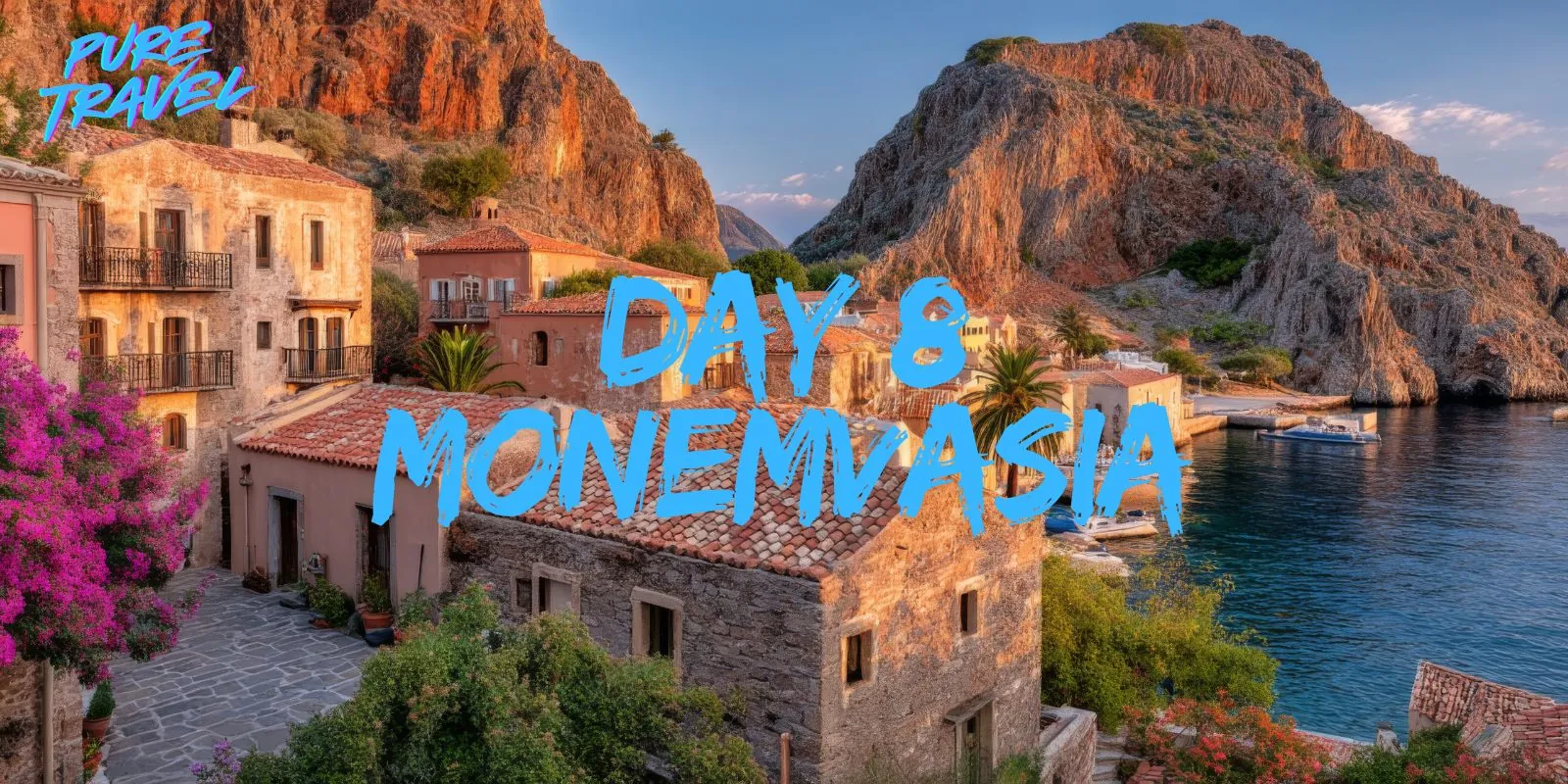
Day 8 Monemvasia: Greece’s Hidden Fortress On The Edge Of Time
Day 8 Monemvasia took us from the serene island of Kythira to Monemvasia — a medieval fortress town carved into a rock rising from the Aegean. From cobbled alleys to Byzantine ruins and sea-view dinners, this journey through Greece’s “Gibraltar of the East” was pure magic.
Introduction: From Island Calm to Castle Walls
After two blissful days on Kythira, it was time to continue our Peloponnesian adventure. The morning air was cool and still as we boarded the ferry back to Neapoli — a short 1 hour and 15-minute crossing that cost €15 per passenger and €40 for our car (~AUD 25 / 67). The sea was glassy calm, sunlight shimmering across the surface like liquid gold.
The closer we drew to the mainland, the more dramatic the scenery became — rugged coastlines, small fishing boats bobbing gently, and the faint outline of Monemvasia’s rock rising from the horizon. After disembarking, we began our 1-hour drive to Monemvasia, the road winding through olive groves and sleepy villages scented with wild thyme and sea breeze.
Morning Journey: Approaching “The Rock”
Nothing quite prepares you for your first sight of Monemvasia. From a distance, it looks like a massive stone island, completely separated from the mainland — a fortress adrift in time. The modern town sits quietly onshore, while the ancient city hides behind the rock itself, invisible from view and accessible only by a narrow causeway.
We parked near the bridge and walked across, the salty wind whipping through our hair. The sound of waves crashed rhythmically against the stone walls below, echoing off the cliffs. Day 8 Monemvasia – Passing through the arched gate of the medieval walls felt like stepping through time — the hum of the 21st century faded behind us, replaced by the echo of footsteps on worn cobblestones.
Afternoon: Wandering the Medieval Maze – Day 8 Monemvasia
Inside the walled town, every corner was a story. Monemvasia’s Lower Town was a labyrinth of narrow alleys, arched doorways, and terracotta rooftops spilling toward the sea. The scent of jasmine and grilled seafood drifted from small tavernas tucked into stone courtyards. Each turn revealed something new — a Byzantine church, a shop selling handwoven scarves, a window with a cat lounging lazily in the sun.
We climbed slowly toward the Upper Town ruins, following an old cobbled path that twisted past low stone houses and flowering bougainvillea. The climb took about 20 minutes, our shoes scraping against centuries-old stones. The higher we went, the quieter it became — only the rustle of wind and the distant cry of seabirds. Entry to the ruins was free, and the reward was spectacular: sweeping views of the Aegean stretching endlessly to the horizon.
At the top stood the remains of ancient walls, arches, and the tiny Church of Agia Sofia, its faded frescoes still clinging to the stone. Standing there, surrounded by silence and sky, we felt the weight of history — battles fought, empires fallen, lives lived and lost — all preserved in the rock.
Evening: Dining Within the Fortress Walls
As dusk settled, we descended back to the Lower Town. The light softened, turning the stone walls amber and the sea silver. We found a small taverna perched on a terrace overlooking the cliffs. The menu was simple but perfect: saganaki cheese (€7 / ~AUD 12), grilled fish (€15 / ~AUD 25), and a carafe of local white wine (€8). The air smelled of salt and lemon, and the only sounds were clinking glasses and the faint hum of conversation in Greek.
We lingered long after our plates were cleared, watching the sky deepen into indigo. The fortress lights flickered on, casting a golden glow over the stone streets. Day 8 Monemvasia – Our guesthouse (€70 / ~AUD 115), a restored stone building tucked inside the walls, was as atmospheric as the town itself — thick stone walls, wooden beams, and windows opening to a sea of stars.
That night, as we lay in bed listening to the waves crash below, Monemvasia felt like a place outside of time — a reminder that some corners of the world still whisper, rather than shout, their beauty.
Pro Traveler Tip – Day 8 Monemvasia
Stay overnight inside the fortress walls if possible. The atmosphere after the day-trippers leave is enchanting — quiet lanes lit by lanterns and the sound of waves echoing through ancient stone. Bring comfortable shoes; the cobbled paths are steep and uneven.
Pro Traveler Warning
Cars are not allowed inside the old walled town. Pack light — you’ll need to carry your luggage through narrow alleys and uphill paths. Many guesthouses offer assistance with small carts, but confirm in advance.
Your Fortress of Stillness
Day 8 was a journey through contrasts — from Kythira’s quiet shores to Monemvasia’s towering rock of history. Walking through its ancient gates, dining by the sea, and sleeping beneath its ramparts felt like living a chapter of Greece’s medieval past. Monemvasia isn’t just a destination; it’s an experience that seeps slowly into your soul, one sunset at a time.
Frequently Asked Questions – Day 8 Monemvasia (Greece’s Hidden Fortress)
Where is Monemvasia located?
Monemvasia is on the southeastern coast of the Peloponnese, about 90 km from Sparta and 300 km from Athens. It’s often called “The Gibraltar of the East” due to its dramatic rock formation rising from the Aegean Sea.
How do you get to Monemvasia from Kythira?
Take the ferry from Kythira to Neapoli (around 1 hour 15 minutes, €15 per person, €40 per car). From Neapoli, it’s about a 1-hour scenic drive to Monemvasia along coastal and mountain roads.
Can you drive inside Monemvasia’s old town?
No, cars are not allowed inside the medieval fortress. You’ll need to park near the entrance or in the modern town and walk across the causeway into the walled city. Pack light or ask your hotel for luggage assistance.
What is Monemvasia known for?
Monemvasia is famous for its medieval architecture, Byzantine churches, castle ruins, and breathtaking sea views. It’s one of Greece’s best-preserved fortress towns, blending history, romance, and coastal beauty.
How much time should I spend in Monemvasia?
While a day trip is possible, staying overnight is highly recommended. The old town becomes peaceful and magical after sunset when day-trippers leave and lanterns light up the cobblestone streets.
Is it difficult to climb to the Upper Town ruins?
The climb takes about 20–25 minutes along a steep cobbled path. It’s moderate but manageable — wear sturdy shoes and bring water. The panoramic view of the Aegean from the top is worth every step.
What can I see inside Monemvasia?
Explore the Lower Town’s narrow alleys, Byzantine churches, and boutique shops, then climb to the Upper Town for the ancient ruins and the Church of Agia Sofia overlooking the sea.
Where should I eat in Monemvasia?
Try one of the small tavernas inside the walls or along the cliffside terraces. Dishes like saganaki, grilled fish, and local white wine are favorites, best enjoyed with sunset views of the Aegean.
What’s the best time to visit Monemvasia?
Spring (April–June) and autumn (September–October) offer pleasant weather and fewer tourists. Summer is beautiful but can be hot and crowded, especially in July and August.
Is Monemvasia suitable for families or seniors?
Yes, but the cobbled paths can be steep and uneven. Families with small children or seniors should take it slow and stay in the lower sections of the old town where it’s easier to walk.